We are publishing here the statement of the Finnish Hydrogen Valley Association on the draft proposal to Parliament for a new Regional Planning Act, with regard to the chapters on which we have commented.
Comments on Chapter 1 General provisions
Thank you for the opportunity to comment on the Government's proposal for a new Regional Planning Act. On behalf of the Finnish Hydrogen Valley Association, we would like to make a few comments and suggestions that may help in the final formulation of the Act.
The aim of the Finnish Hydrogen Valley Association is to promote the conditions for the economic exploitation of the production potential of renewable energy and hydrogen economy and the development of business based on these in eastern Finland. The aim is to attract significant investments in renewable energy and hydrogen economy to eastern Finland and to form a network of subcontracting and cooperation, i.e. a cluster. The aim is to make eastern Finland a genuinely attractive environment for investment.
The national hydrogen strategy will make Finland the leading hydrogen economy in Europe. The Government's decision in principle in 2023 will make our country the leading hydrogen economy in Europe by 2035. The goal is to account for at least 10% of the EU's green hydrogen production by 2030. Clean hydrogen can also be used in sectors where direct electrification is not possible, such as the steel and chemical industries. The European Commission also aims to phase out the burning of fossil fuels and the use of raw materials.
Finland is well placed to develop a hydrogen economy, especially on a European scale, thanks to cheap electricity, the scaling up of electricity production and other competitive factors. It is therefore important to take care of the conditions for the hydrogen economy and not to start undermining them, at least through legislation. The current provisions in Chapters 8 and 9 are preventing the development of a business environment and effective competition in a situation in which our country should prefer to take the lead in the competition for market shares. The bill also runs counter to other objectives of the government programme, including increasing the production of renewable electricity and industrial investment based on it.
With regard to the draft law, it should be noted that the environmental impact of renewable energy sources such as wind and solar power projects is already regulated in great detail, both in planning, environmental law and the EIA process.
Comments on Chapter 4 Regional planning
The draft regional plan increases the flight altitude from the current level. The role of the regional plan has so far been very guiding towards the municipalities, now the role of the municipal master plans is emphasised. Under the draft law, municipalities may deviate from the content of the regional plan in joint master plans. This may undermine the predictability of planning and create uncertainty in the investment climate. Chapter 8 on wind power changes, or even weakens, the guiding force of the regional plan and creates new pressure on municipalities.
Comments on Chapter 8 Special provisions for wind energy construction
The proposal in the bill to impose an exceptionally long distance requirement for the siting of wind turbines is peculiar. An eightfold spacing in relation to the overall height of the wind turbine is a departure from all other legislative logic, because there is no justification for it and it does not take account of the so-called normal impact assessment. Extending the distances as proposed will lead to a wide range of negative impacts, not only on wind power construction, but on the entire clean transition investment.
The logic of the regional plan is that it tries to find suitable sites for wind turbines, but these are not always the areas where the final investments will be made. Each province has its own operating conditions and zoning culture, so the proposed legislation would not have a positive impact on promoting wind energy. Although the distance requirement does not apply to wind farms subject to provincial planning, it may change the culture of municipalities and the rule would be enforced, further reducing the number of wind farms.
According to studies by both FCG (commissioned by the Ministry of the Environment) and LUT University, increasing the distances between wind turbines will radically affect the possibility of building them. According to the FCG report, even a minimum distance of 1.5 km would impose significant constraints on new wind projects. According to the report, the additional electricity demand from clean industry would not be jeopardised if the distance were set at 800-1000 metres. A distance greater than this would limit wind energy development in a way that would jeopardise the increase in electricity production. The impact of increased distances on wind power generation is particularly high in southern and much of eastern Finland, where wind power is already a challenge to build, as well as near large population centres. Existing projects of Renewables' member companies are also likely to be discouraged in large numbers, as only some of them are subject to regional planning.
An eightfold distance would reduce the number of projects by at least 64% at the sites studied.If we end up with an eightfold distance, this would mean two kilometres for current power plants and up to three kilometres with technological advances. It is clear that this situation is not conducive to increasing production or to the technological development of wind turbines. The development of wind turbines is not only about increasing output through height and technology, but also about reducing noise pollution, which is becoming increasingly important. Wind turbine designers and manufacturers want to contribute to the development of the market, taking into account the needs of the environment and people. A distance requirement would take the market in the wrong direction, at worst by holding back older, less productive technologies, which would also make electricity prices worse for consumers.
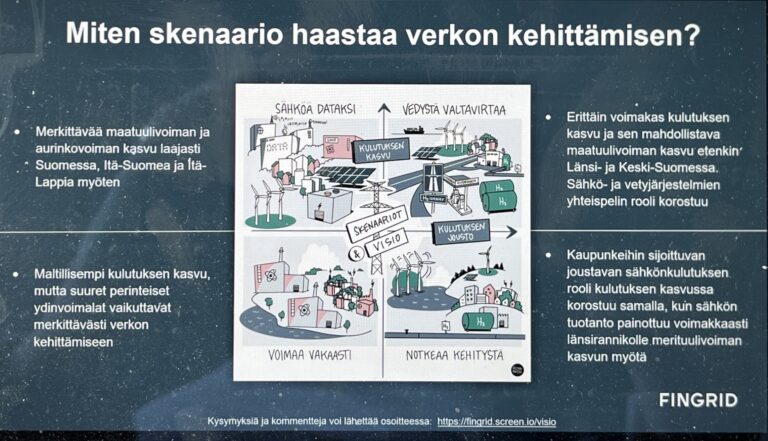
If the distance requirement were to be implemented, it would also lead to an increased need for electricity transmission, as wind turbines would be concentrated further north. Increasing distances between electricity production and consumption would increase the need for transmission network construction and the cost of transmission losses, which would affect electricity costs for consumers. The increase in wind power generation would also be concentrated in a smaller geographical area, increasing the cost of the flexibility resources needed to balance the electricity system. There are already major challenges in terms of electricity transmission, with production in the north and consumption in the south, and this discrepancy would be exacerbated by the draft law.
According to the clean transition investment data window compiled by the European Commission, the largest potential for green transition investment is in onshore wind power, where other green transition investments such as hydrogen, chemicals, steel and basic industries will also base their growth. If Finland wants to be one of Europe's leading energy producers and players in the hydrogen economy, and if the aim of the government programme is to increase renewable electricity production and the industrial investments based on it, there is no justification for the distance claims made for wind power. If wind power cannot be invested in in the more southern parts of the country, there will be no investment to exploit it. This will continue to lead to declining industrial development, fewer jobs, falling tax revenues for municipalities and a loss of vitality. Finland needs the growth potential offered by the clean transition, which will not be created in a global market in a highly competitive environment by limiting its own conditions.
When looking separately at regional development in eastern Finland and the potential for wind power and clean transition, the above risk factors may correlate and lead to a more challenging future near the eastern border. Eastern Finland's potential for wind power has already been severely limited by the needs of the Defence Forces to control the eastern border. Wind power generation in the East is also a good way to increase the vitality of the regions and at the same time produce significant amounts of renewable energy for the EU's green industry. The potential for wind power is significant and wind conditions are good, given that conditions in the different wind zones balance and disperse production, also ensuring production during peak demand periods.
Solutions to control the eastern border can be found and, with the support of wind power investment, the region would have the potential for large-scale investment in the hydrogen economy in its various forms along the value chain. It would also provide new added value for the forest industry, which is concentrated in the region, through the exploitation of its side streams (biogenic carbon dioxide) and could better guarantee the future prospects and jobs of factory integrators. The development of an energy system in eastern Finland would attract clean transition investments in production and consumption, improving the security and vitality of the region, employment, entrepreneurship and the economy of municipalities; the whole of Finland will benefit from this growth opportunity that the hydrogen economy can offer.
Our proposal: if and when we want to grow Finland into Europe's leading energy and hydrogen economy, the investment potential must not be undermined by legislation whose impact has not been sufficiently assessed. It would be desirable for the government to reconsider its proposal and to commission a much more accurate and careful impact assessment of the actual effects of a possible fixed distance on wind power projects. At the same time, the impact on other clean-shift investments, the construction sector and employment should be examined.However, the best solution for determining wind power distances is to assess the impact of the turbines, as has been the case so far, rather than a fixed distance.
Comments on Chapter 9 Specific provisions for solar installations
The draft law is new in this respect, introducing a new instrument in the form of a solar power master plan. With the strong growth of solar power, the proposal is a good one and will ensure a positive development in the future. Solar power is playing an increasingly important role in clean energy production, complementing wind power production, as the peaks in production are usually at different times. However, it is desirable that the new law does not lead to more complicated planning procedures for smaller solar projects. The construction of solar parks is already relatively tightly regulated and the proposed new lower size limit for projects to be zoned could slow down solar investment. It will also increase the burden on municipalities as the number of planning applications increases. The draft law could be amended to leave out the size limit and rely on impact assessments, as has been the case so far.
-