
ResliEast programme
ResilEast is an innovative, defence-oriented energy programme that combines the development of civil society and national defence infrastructures with energy production and maintenance in a cost-effective way.
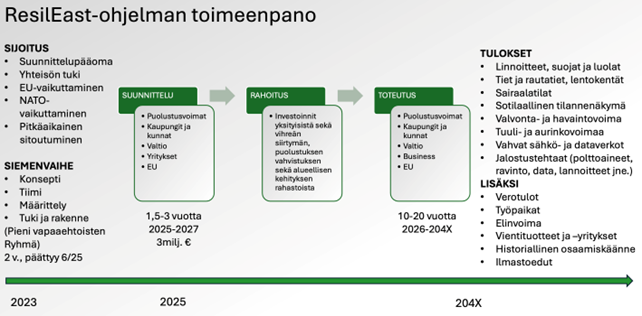
ResilEast enables solutions where military infrastructure such as roads or shelters, which are by-products of energy infrastructure, can be used for other productive uses in peacetime. The programme will increase our country's resilience, defence capabilities and economic growth through downstream products from renewable energy.

ResilEast responds to the security challenges of Finland and the EU's eastern border and the transition to a carbon-neutral energy economy. The programme supports the EU's strategy for a Preparedness Union, President Niinistö's report, and Mario Draghi's Defence, Digitalisation and Decarbonisation EU Strategy. ResilEast is a follow-up to the Eastern Finland Programme.
Energy economy
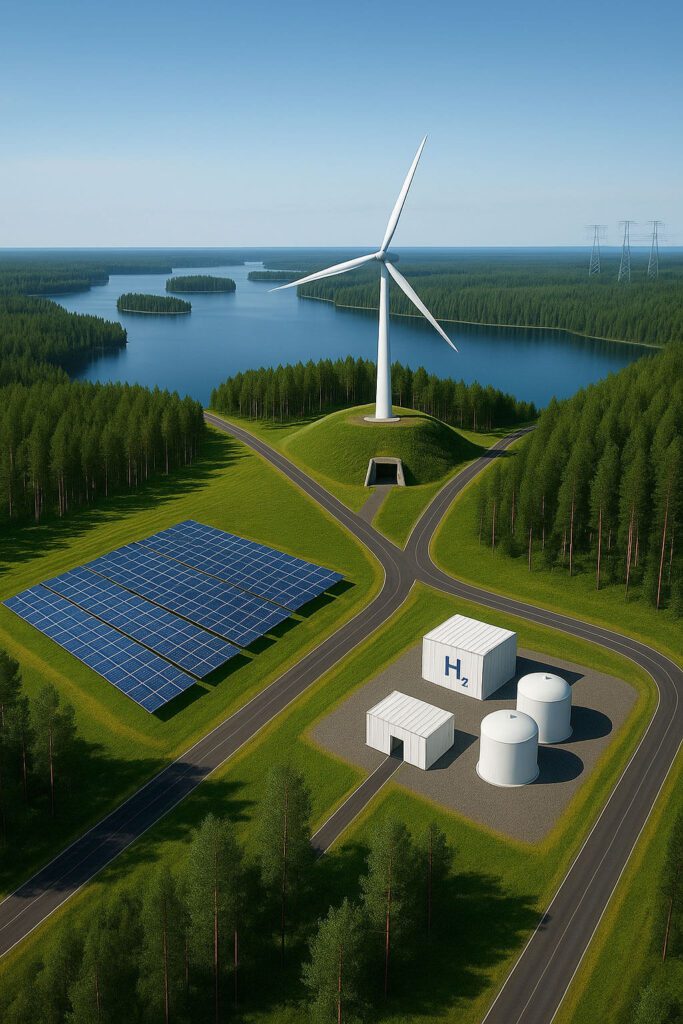
The development of energy production and transmission networks, and the processing of energy into more valuable products, is a key part of the ResilEast programme. The end products of energy processing include heat, electricity, data, fuels, fertilisers, food, raw materials such as steel and carbon fibre.
National Defence
The programme will improve military mobility, information flow, fortification and infrastructure, enabling more effective defence and crisis preparedness in a cost-efficient way, with the support of civil society.
Economics
The implementation of the ResilEast programme will generate significant economic benefits such as tax revenues, cash flow, jobs and investment. According to a conservative estimate (LUT University), the wind power potential in Eastern Finland is already 6 186 wind turbines, which would mean a total turbine investment of about € 37 billion. The economic impact, calculated over a 46-year lifetime, is:
- Increase in BTK €205 billion
- Tax revenue: €83 billion
- Person-years: 587 000
- Energy production: 126 TWh/year
In Finland, about 24 million tonnes of wood-based carbon dioxide emissions are produced annually, the majority of which are generated by paper and pulp mills in South Karelia and eastern Finland. Carbon dioxide capture could be used to convert these emissions into a resource that is needed, for example, in the green hydrogen economy, where hydrogen is used to make chemicals and synthetic fuels.
According to a study by VTT, the value of products made from carbon dioxide could be up to EUR 7 billion by 2040. According to a study by LUT, the recovery of wood-based carbon dioxide would more than double the turnover of the Kaukopää and Tainionkoski factories.
EU and NATO
The ResilEast programme area can be extended to cover the entire eastern border of the EU and NATO, as well as the Baltic Sea region. The aim is for eastern Finland to take the initial and pilot responsibility for developing the programme as other eastern European regions and Europe's contribution grows as the programme progresses.
Funding
The programme will bring in both private funding and, with sufficient scale and a holistic approach, will also improve the chances of EU funding. In this context, Finland will have the opportunity to claim its share of the infrastructure costs for the defence of the border (1 340 km), support for innovative solutions and the costs of energy transmission networks. The programme is a productive solution as part of NATO's financial commitments in support of defence. Without productivity-enhancing solutions, the 1.5% of GDP target will be difficult to achieve in a politically sustainable way.
Implementation
For more information, visit
Jari Sistonen 040 551 0580 jari.sistonen@u-cont.fi
(ResilEast package, defence support)
Petteri Laaksonen 040 508 8498 petteri.laaksonen@lut.fi
(energy, wind power, economic impacts)
Jami Holtari 0400 551 435 jami.holtari@vetylaakso.fi
(role of hydrogen, societal impacts)
Joonas Hänninen 040 676 5544 joonas.hanninen@varkaus.fi
(social impacts, role of municipalities)